
A World (Cup) of Joy
An update and a recent sermon

Hi Everyone,
I wanted to give a quick update on what I’ve been up to for those of you who know me and then below you’ll find a recent sermon called A World (Cup) of Joy.
I continue to enjoy helping at the church where I met my wife, was married, and was ordained. It’s incredibly rewarding to be able to use my church experience without the pressure of being the senior pastor. I also have a steady “soul coaching” practice. I love working with people one-on-one to support them in living more centered lives and feel more connected to the Mystery. You can learn more about what I mean by soul coaching on my Substack page HERE. And finally, I’ve just started a new project with Valiant Living, an addiction recovery center in Greenwood Village. It’s just a few hours a week, but I lead a group session with the men in residence focused on spirituality. I used to do a lot of men’s work at my old church and it’s a joy to be back in a circle of people committed to being vulnerable and going deeper together.
When I’m not working, I’m enjoying time with family, camping, and watching more of the World Cup than is probably healthy. For those of you who know about our son’s journey with a brain tumor, I’m happy to report he is doing well and headed to Chile this fall as part of his study abroad at CU Boulder. He and I leave tomorrow for Georgia where we will get to see Argentina play Egypt in the World Cup, thanks to their wins today (whew). I am deliriously excited to witness the energy of Argentina’s fans, see Messi, Salah, and, oh yeah, visit my parents too. :-)
Finally, I’ll brag a minute and mention that I’ve been asked to give a lecture at “Preaching in an Age of Contempt,” a preaching conference this fall at The Iliff School of Theology here in Denver. I’m quite honored, and a little nervous, about it. For you minister-types who might be interested in attending, here’s the link to learn more (Will Willimon will be one of the presenters):
https://www.iliffpreachingconference.com
Okay, enough for now. Here’s the sermon. I’ll include the video of it first. If you prefer reading, you’ll find the text below.
Matthew 13:44
The kingdom of heaven is like treasure hidden in a field, which a man found and reburied; then in his joy he goes and sells all that he has and buys that field.
Today we find Jesus going on about his favorite subject again. More than any other topic, he comes back to it repeatedly…trying this way and that way, using this image and that image, hoping to find the right words to describe…the kingdom of heaven. More than 30 times in Matthew’s gospel he compares it…to a farmer sowing seed and a merchant searching for pearls. It’s like a net thrown into the sea, he says, and a landowner hiring laborers. It’s like a mustard seed. It’s like yeast. And today…it’s like a treasure hidden in a field.
But why is this treasure hidden? And why does the man, having found it, rebury it? Why, instead of pocketing the diamonds and gold, does he head to the nearest pawn shop, sell everything he owns, and buy the field the treasure’s in?
To try to answer these questions, I want to start in an unlikely place this morning…the World Cup is in town!
Well, not literally in town, unfortunately, but in cities around the US, Canada and Mexico, a few million people are pouring in from around the world, and billions will watch from home - a 39-day soccer tournament between 48 countries that only happens every four years.
And even despite the troubling level of commercialism, greed, and corruption that something like this engenders, and even if don’t count yourself as a fan of “the beautiful game,” I hope you can still appreciate the way the World Cup brings people together like one big cultural-exchange program.
People from Africa, Europe, Asia and the Americas are experiencing some of America’s great cultural icons like the bison of Yellowstone, the Lincoln Memorial, the Waffle House, and Buc-ee’s convenience stores.
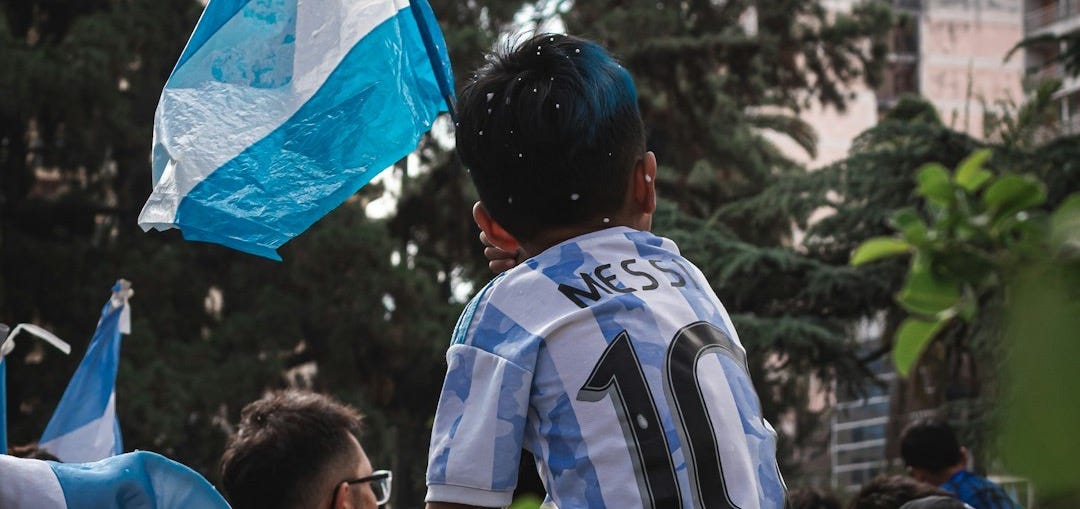
And one of the truly beautiful things happening in this World Cup is the collective outpouring of the human spirit. People are gathering in huge crowds, just to dance, sing and have fun. Yes, in support of their team and their country…but more than any World Cup I’ve seen, this one feels like a celebration of being alive, of being human, and of being connected in a way that’s deeper and more fundamental than the geographical and political boundaries that divide us.
In case you’re not as glued to this global party as I am, I put together a few video clips to give you a taste of it. The first clip is one I took at an Argentinian-owned bakery here in Denver called Maria Empanada’s. I got there an hour before Argentina played Austria last week in a group-round match and the crowd was already spilling onto the street…
https://share.icloud.com/photos/01463QKM7kEQZcCBp_EpPVezg
Second is a clip of Dutch fans, who are famous for gathering in huge crowds of bright orange as they dance their way to the games…
https://youtube.com/shorts/IjIyMHKBEJI?si=jxKdehnWn_8k4PwR
Third is an example of an unlikely friendship that has formed between South Korean and Mexican fans. This is a young South Korean (in red) who found himself in the middle of a crowd of Mexican fans when they decided to start throwing him in the air (in a nice way)…
https://youtube.com/shorts/IGWyclD01SQ?si=-5ozJrZwaH-NyNmX
Fourth, we have Scottish fans having a party before their game outside the stadium in Miami…
https://youtube.com/shorts/PAun6_2IQXE?si=D5QGkkweekKP9k2i
Being of Scottish descent, I’m not sure if that clip makes me proud to be Scottish or not. And finally, we can’t leave out the US fans. Here are roughly 67,000 of them singing John Denver’s “Country Roads” after one of their recent wins…
https://youtube.com/shorts/XbMkSqSsfBQ?si=RUKr2KRPwe9hsuEa
Pretty cool, eh? But, of course, for every clip like these, I could show five more of fans watching their team in utter agony – biting their nails at every penalty kick, worried when their team is down, brought to tears when they get knocked out.
I know it’s just a game. But being a fan (of any sport) teaches us something beyond sports. In order to experience the kind of joy and celebration in those clips, we have to be willing to risk the possibility, indeed the inevitability, that sometimes we will lose. And it will hurt.
There’s no getting around it, in sports or in life. Joy and sorrow are not so much opposites, as deeply entangled aspects of the same truth. And our ability to experience the former is in direct proportion to our willingness to risk the latter. Our capacity to deeply feel joy is inextricably linked to how deeply we are willing to feel…everything else.
We want more joy, and we don’t want pain. So we dampen our openness to suffering, by distracting ourselves, medicating ourselves, and lying to ourselves. But in doing so we also dampen our ability to feel the good stuff too.
We need something I’ve started to call deepgevity…a word I am officially entering into the public lexicon today, so when it goes viral and I’m on talk shows pushing my new book about it, you’ll know where it all started. The idea of deepgevity came to me one day when I had seen one too many podcasts, documentaries, supplement commercials and newsfeeds on the subject of longevity.
For the last few years, longevity has been having a cultural moment, spawning bestselling books like Outlive and Lifespan, billionaires like Bryan Johnson obsessed with reversing the aging process, and a flood of wearable devices tracking every biomarker we can think of.
Taken to an extreme, longevity culture becomes a form of death denial, in which we think of our bodies as projects; objects to be optimized, rather than as the already-beautiful, intrinsically-sacred, and inevitably-limited gifts from God that they are.
At its core, longevity is a beautiful and worthy pursuit, focused on extending not just lifespan but healthspan — It’s about wanting to be able to hike, and play with the grandchildren, and have clear minds into our 80’s and beyond.
But when we focus too much on longevity, we can make the mistake of thinking a long life is necessarily a good life. Or that to have a good life, one must necessarily have a long life. But I have known people who died when they were 20, whose lives were enviously rich and full. And I have known people who made it to 100, who hardly lived at all. Longevity is important. But it’s not that important.
The other thing I find people placing too much importance on is what I call widegevity. This is when people think the important thing in life is not how long we’re here, but how many amazing experiences we have while we’re here. They spend their lives one Instagram-worthy-moment to the next…scuba diving or climbing a mountain or sipping wine by a lake in Italy.
Widegevity is having a bit of a moment too. We see it in the popularity of “experience” travel like cruises to Antarctica and African safaris. We see it in all the apps, journals and lifestyle brands built around cataloguing experiences we can check off on our bucket list.
If longevity is about the length of our lives, widegevity is about their breadth. And if longevity culture lives on health podcasts and biometric dashboards, widegevity culture lives on Instagram and TikTok.
And like longevity, widegevity has its healthy side. Amazing experiences are, well…amazing. Going to new places grants us access to people and ideas we wouldn’t normally be exposed to. Peak experiences challenge us and pull us out of ruts and routines that keep us small.
But the shadow side is a temptation to turn our lives into a series of curated, shareable artifacts. At worst, widegevity turns our experiences into content, something to capture, possess and post.
And on a more subtle level, if only extraordinary moments count, then the rest of life can feel like a waiting room where nothing significant is happening. A quiet meal or a walk in the neighborhood don’t seem special enough by comparison. We become less sensitive to the blessings of the everyday, and we lose our capacity for ordinary wonder. But those ordinary moments ARE special. Every moment of existence contains a fathomless depth of meaning and mystery.
Which is why we need deepgevity, a focus not on how long we live, or how widely we live…but on how deeply we live. How observant can we be of the world around us? How sensitively can we touch the moment in front of us? How profoundly can we let ourselves feel, not just the beauty and the joy of life, but the pain and struggle of it too?
This, to me, is the secret. It’s the treasure hidden in the field. Could it be that the reason the man in Jesus’ parable doesn’t just make off with the diamonds and gold is because the kind of treasure Jesus is talking about isn’t something we possess. It’s something we experience. We can’t buy it. We can only buy the field that contains it. In other words, we can learn to be present to it.
But even that will require that we give up things, sell off whatever gets in our way and keeps us from seeing it. And maybe that’s why the treasure remains buried. Because most of the world, most of the time, walks right by it, worried and distracted, on our way to somewhere important.
It’s only when we open our eyes and open our hearts deeply to this crazy world (cup) of joy, sorrow, wonder, and beauty…it’s only when we find the courage to root for our team, even though they will lose, and dance in the street, even though we will look silly, and love with real vulnerability, even though it will hurt, that we will then understand why Jesus talked so much about the Kingdom of Heaven.
Thanks so much, Ian, for another profound and enjoyable reflection. It's great to hear about son Ian. Have fun in Atlanta; hopefully without all the rain.
Ian what a great message on « deep jevity « 😊💕🙏🏽